
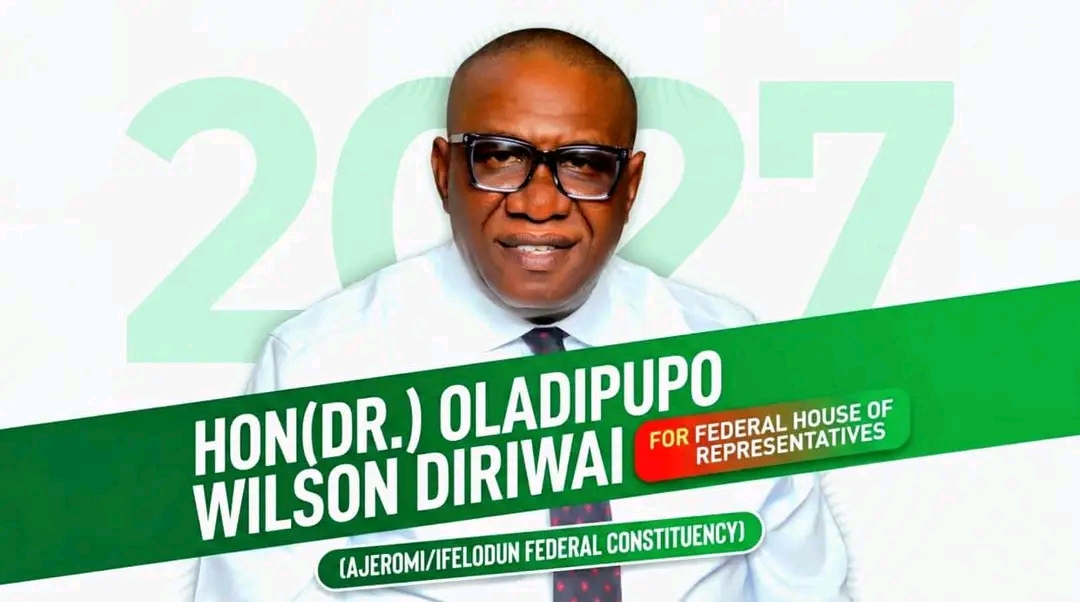
In Ajeromi Ifelodun, the name Dr. Oladipupo Wilson Diriwari has increasingly entered the political conversation. But to understand the man seeking to represent the constituency, perhaps the first question should not be “What does he want?”
A more important question is:
“What made him?”
Dr. Diriwari was born and raised in Ajeromi Ifelodun. His early life was not insulated from the difficulties experienced by ordinary families in Ajegunle. According to accounts of his life, he lost his father at a young age and was raised by his mother, a primary school teacher. He has publicly described knowing what it means to struggle for food, education and survival.
That detail matters.
Because politics is ultimately about people, and people are shaped by the realities they have experienced.
Some people encounter poverty only through statistics.
Some encounter unemployment through economic reports.
Some discuss educational inequality at conferences.
Others grow up seeing these things at close range.
Diriwari’s professional journey subsequently took him far beyond the streets where he grew up. He became a lawyer with professional experience extending across Nigeria and the United Kingdom. Reports on his political emergence identify him as a Barrister and Solicitor of the Supreme Court of Nigeria and a Solicitor of England and Wales, with extensive experience in legal practice.
But perhaps the more interesting part of the story is not how far he travelled.
It is that he continued to look back.
In April 2026, The Nation reported that Diriwari, through the OWD Foundation, facilitated JAMB registration for academically promising students in Ajeromi Ifelodun. The publication also reported that his educational intervention had, over several years, included WAEC and GCE registration support for hundreds of beneficiaries.
That raises an important question about political leadership:
Should representation begin only after a candidate wins an election?
Or should the public examine what a person has been doing before asking for public office?
That question deserves serious attention.
In May 2026, the Ajeromi Ifelodun chapter of the PDP adopted Diriwari as its consensus candidate for the House of Representatives seat. At the event, he declared that his representation would not be that of a passive legislator and said he would not go to the National Assembly merely to become an “I concur” member.
Those are political words.
And political words should never be enough.
The real test is whether a person’s history, competence, ideas and actions can withstand public examination.
That is why the next 60 days should not simply be about slogans.
They should be about the man, the constituency and the issues.
Who is Dr. Diriwari?
What has shaped his worldview?
What has he done before seeking public office?
What does he understand about Ajeromi Ifelodun?
What does he believe a legislator should actually do?
What are his ideas about education, employment, youth development, small businesses, infrastructure, security and the dignity of ordinary people?
And perhaps the most important question:
Can his experience be translated into effective representation?
These are the questions worth asking.
Because democracy is stronger when citizens examine candidates beyond posters, crowds, party colours and political excitement.
A candidate should not be judged merely by how loudly supporters praise him.
He should be examined by his record, competence, character, ideas and capacity to serve.
So, before we discuss Dr. Diriwari the politician, let us first understand Dr. Diriwari the man.
The journey begins here.
DAY 1 OF 60
The story before the politics.