
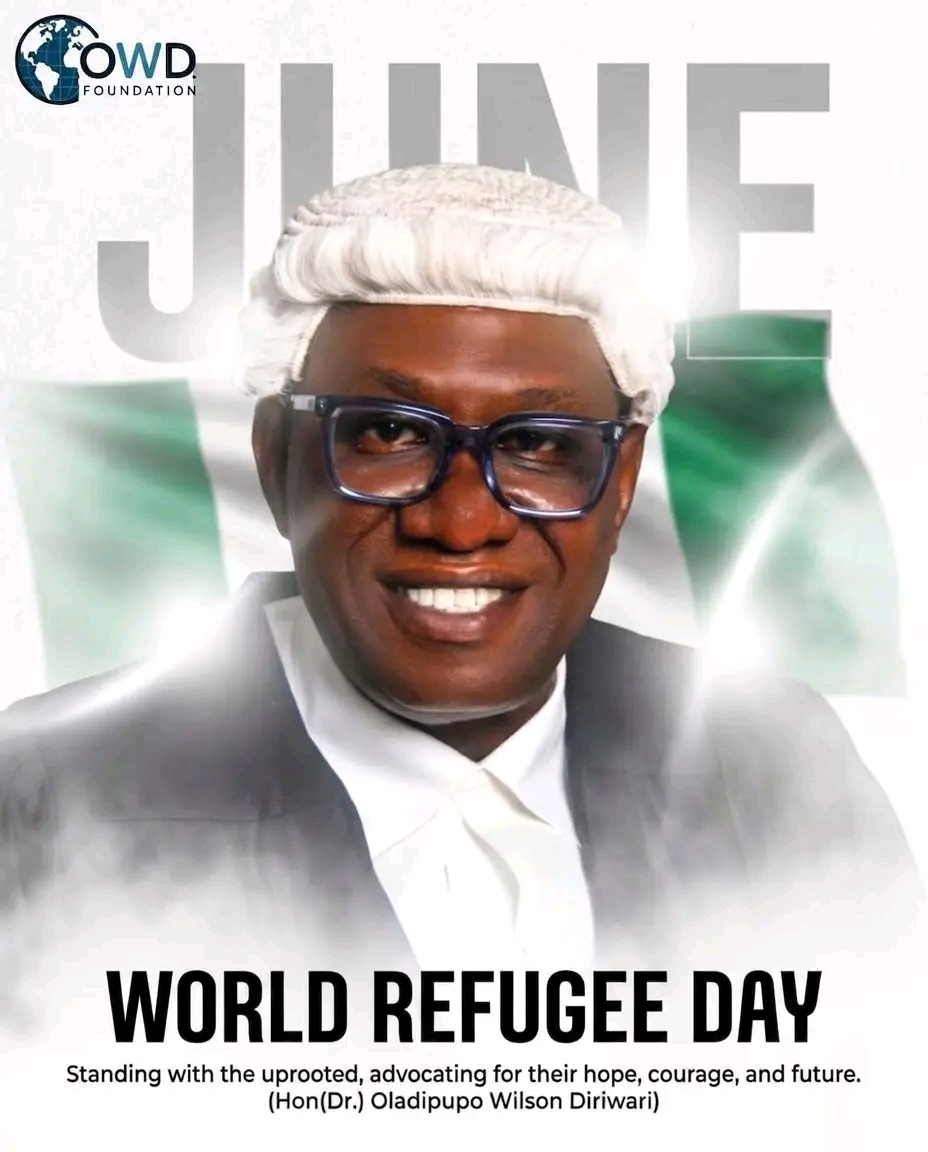
When the Law Turns Its Back on the Living
On World Refugee Day, we must ask not just what has gone wrong — but who is accountable, and what we owe to those the world has abandoned.
By Dr. Diriwari
Legal Scholar & Public Affairs Advocate | Ajeromi Ifelodun
Every year on the twentieth of June, the world observes World Refugee Day — a date designated by the United Nations to honour the courage, strength, and resilience of millions of people who have been forced to flee their homes due to conflict, persecution, and disasters not of their making. The origin of this date is itself instructive: it marks the anniversary of the 1951 Refugee Convention, the foundational international legal instrument that was supposed to make civilisation’s promise to the displaced irrevocable. Seventy-five years after that Convention was adopted, we must gather not merely to commemorate, but to confront an uncomfortable truth — the promise has been broken, and it has been broken with impunity.
As a legal scholar, I have spent considerable time studying the architecture of international humanitarian law. I have read the Convention’s elegant language about non-refoulement — the principle that no refugee shall be returned to a territory where they face serious threats to their life or freedom. I have studied the Protocols, the UNHCR Statute, the African Union’s own Kampala Convention of 2009. The legal framework, on paper, is robust. But law is not self-executing. And a right that cannot be enforced is not a right — it is a prayer.
THE SCALE OF THE CRISIS
122 Million+
People forcibly displaced worldwide in 2026
43 Million
Refugees under UNHCR’s mandate
76%
Hosted by low- and middle-income countries
17 Years
Average duration of major refugee situations
The Geography of Abandonment
The statistics above are not abstractions. They are human beings. They are the Sudanese mother who watched her children drink muddy water from a displaced persons camp in Chad. They are the young man from South Sudan who crossed into Uganda on foot with nothing but the clothes on his back and a photograph of his father — a father who did not survive the journey. They are the Syrian engineer, now twelve years displaced, whose doctoral degree is unrecognised in the third country he has resettled in. They are the Congolese pastor who continues to hold prayer services under torn tarpaulins in Malawi because faith, unlike political will, does not abandon the suffering.
What is deeply troubling — and legally significant — is where the weight of this global crisis actually falls. The wealthiest nations of the world, which possess the greatest capacity for absorption, resettlement, and financial contribution, host a disproportionately small share of the world’s refugees. Countries like Turkey, Iran, Colombia, Pakistan, Uganda, and Ethiopia — economies that themselves wrestle with poverty, unemployment, and political instability — shoulder the majority of this burden. This is not generosity from the powerful; it is abdication dressed in diplomatic language.
“When powerful nations erect walls, tighten asylum rules, and pay poorer countries to keep refugees from reaching their borders, they are not protecting national security. They are exporting human suffering to those least able to bear it.”
Africa’s Double Wound
As an African, and specifically as a Nigerian, I cannot speak about the refugee crisis without naming Africa’s peculiar position in this tragedy — for Africa is simultaneously the world’s most prolific producer of refugees and, in relative terms, one of its most generous hosts. This is not a coincidence born of geography alone; it is the consequence of a history we did not choose. The conflicts that drive displacement across our continent — in Sudan, in the Democratic Republic of Congo, in Somalia, in the Sahel, in Mozambique — are not spontaneous combustions. They are fires fed by decades of arms trafficking, manipulation of political transitions, extraction of natural resources that funds militias, and the willful neglect of post-colonial states whose borders were drawn by strangers in European conference rooms.
And yet, when Africans displaced by these very forces attempt to seek safety beyond our continent’s shores, they are met with walls — literal and legislative. They are called “economic migrants,” a phrase deployed with surgical precision to strip them of legal protection. They are pushed back into dangerous waters by coast guards operating under policies that courts in several countries have since declared unlawful. The 1951 Convention was written partly in response to the failure of the international community during World War Two. One would have hoped the lesson had been learned. It has not.
Nigeria’s Own Reckoning
Within our own borders, we must also be honest. Nigeria is both a country of origin and a country of asylum. Over three million Nigerians remain internally displaced — primarily in the Northeast following the devastation wrought by the Boko Haram insurgency and its successor factions. The conditions in many of our Internal Displacement Camps are an affront to human dignity. I have spoken with displaced persons from Borno, Yobe, and Adamawa. Their stories carry a common thread: the displacement itself was traumatic, but what has broken many of them is the duration — the sense that they have become permanent guests in their own country, that return is a promise their government made in election campaigns but has never honoured.
At the same time, Nigeria hosts refugees from Cameroon, Chad, Niger, and others. There is a vast gap between our ratification of international instruments and their domestication into enforceable national law with adequate funding. A signature on a convention is not the same as a budget line. It is not the same as a trained asylum officer. It is not the same as a functioning refugee status determination process that treats human beings with the dignity the law demands.
LEGAL FRAMEWORK NOTE: Nigeria is a signatory to the 1951 Refugee Convention and its 1967 Protocol, as well as the 1969 OAU Refugee Convention. The National Commission for Refugees Act provides domestic legal backing. However, operationalisation remains inconsistent. Reforms aligning domestic law with the Kampala Convention on Internal Displacement are long overdue.
What the Law Demands — and What Humanity Requires
There are those who argue that the refugee system is being abused — that economic desperation is being disguised as persecution to exploit humanitarian pathways. Even if we concede that verification reforms are necessary in specific contexts, the response cannot be to make protection so difficult to access that genuine refugees are functionally excluded. When you make the door of protection so narrow that only those with legal literacy and physical resilience to navigate labyrinthine bureaucracies can enter — you have not reformed the system. You have abolished it by stealth.
From a legal standpoint, the principle of non-refoulement is widely regarded as part of customary international law — binding on all states regardless of whether they have ratified the 1951 Convention. Governments that violate it must be held accountable before international tribunals, regional courts, and the court of history.
“The refugee is not a charity case. The refugee is a rights-holder. The distinction is not semantic — it is the difference between begging and claiming what is lawfully owed.”
A Call to Concrete Action
World Refugee Day must not become a performance of compassion — a single day of hashtags, candlelight vigils, and ministerial statements that change nothing by the twenty-first. I want to close with what I believe are the minimum requirements of our political and legal moment:
ONE: Every African Union member state must domesticate the Kampala Convention on Internal Displacement into binding national legislation with real funding, timelines, and accountability mechanisms. Ratification without domestication is window dressing.
TWO: Nigeria must overhaul the operational capacity of its National Commission for Refugees. Refugee status determination must be timely, fair, and conducted by officers trained in international protection standards, free from corruption and bureaucratic inertia.
THREE: African nations must speak with one voice in international forums demanding that burden-sharing provisions of the 1951 Convention framework be made legally enforceable. Wealthy nations cannot continue to fund border externalisation programmes while invoking the language of human rights.
FOUR: In communities across Nigeria — including here in Ajeromi Ifelodun — we must cultivate a culture that sees the displaced person not as a burden or a threat, but as a neighbour deserving of dignity. Xenophobia in African cities toward other Africans is a wound we inflict on ourselves.
The Measure of Our Civilisation
The refugee crisis will not be solved by more tents, more food rations, or more impassioned speeches on June twentieth. It will be solved when the political will exists to end the conflicts that drive displacement, to prosecute those who commit the atrocities that force people to flee, and to honour — without evasion or exception — the legal commitments that nations have voluntarily made.
On this World Refugee Day 2026, I call on every Nigerian leader, every African head of state, every member of our National Assembly and State Houses of Assembly: do not let this day pass as theatre. The people in the displacement camps are watching. The children growing up stateless are watching. History — which has a longer memory than any electoral cycle — is watching.
The law is clear. Our obligations are clear. What remains is the decision to act as though the lives of the displaced matter as much as the votes of the comfortable. That decision is political. It is moral. And it is, above all, human.
“They did not choose to flee. We must choose to act.”
Dr. Diriwari | Legal Scholar & Public Affairs Advocate | Ajeromi Ifelodun | June 20, 2026